Estimated reading time: 4 minute
Table of Contents
- What is Body Condition Scoring (BCS) in Dogs?
- Why Should I Do a Body Condition Scoring?
- How to Score Body Condition?
- Step 1: View from Above – Body Silhouette Assessment
- Step 2: Side View – Body Silhouette Assessment
- Step 3: Evaluating the Ribs
- Step 4: Using the Body Condition Scoring Chart
- What Should I Do If My Dog Is Not in Ideal Body Condition?

What is Body Condition Scoring (BCS) in Dogs?
Body Condition Scoring (BCS) is a simple technique used to determine whether your dog is underweight, ideal or overweight. This method helps you determine how much food to feed your dog and maintain a healthy weight.
Why Should I Do a Body Condition Scoring?
Maintaining a healthy weight throughout your dog's life reduces the risk of disease and can extend lifespan.
How to Score Body Condition?
To assess your dog's body condition, you can follow these four simple steps:
Step 1: View from Above – Body Silhouette Assessment
• When you look at your dog from above, there should be a distinct waist behind the ribs.
• This appearance shows that the dog has the ideal body shape described as an “hourglass shape.”
• While this is more easily noticed in short-haired dogs, you may need to move your hands along the dog's side to feel this shape in long- or thick-haired dogs.
Step 2: Side View – Body Silhouette Assessment
• Look at your dog from the side. In a dog in ideal body condition, the abdomen should appear to be “pulled in” upwards behind the ribcage.
• In long or thick-haired dogs, you may need to move your hand from the rib cage to the belly to feel this shape.
Step 3: Evaluating the Ribs
• Place your hands just behind your dog's shoulders, on either side of his ribs, and run your fingers lightly over his ribs.
• In a dog in ideal body condition, the ribs should be easily felt but covered by a very thin layer of fat.
• This feeling should be like touching the bone structure on the back of your hand when you open your hand with your palm facing up.
• Note: When making an assessment, keep in mind that the amount of fat between the front and back of the ribs may be different. Therefore, it is more accurate to score at the front of the ribs.
Step 4: Using the Body Condition Scoring Chart
• Following the assessments above, use the Body Condition Scoring (BCS) chart to determine your dog's body condition. (You can find this information on the WSAVA website) apply.
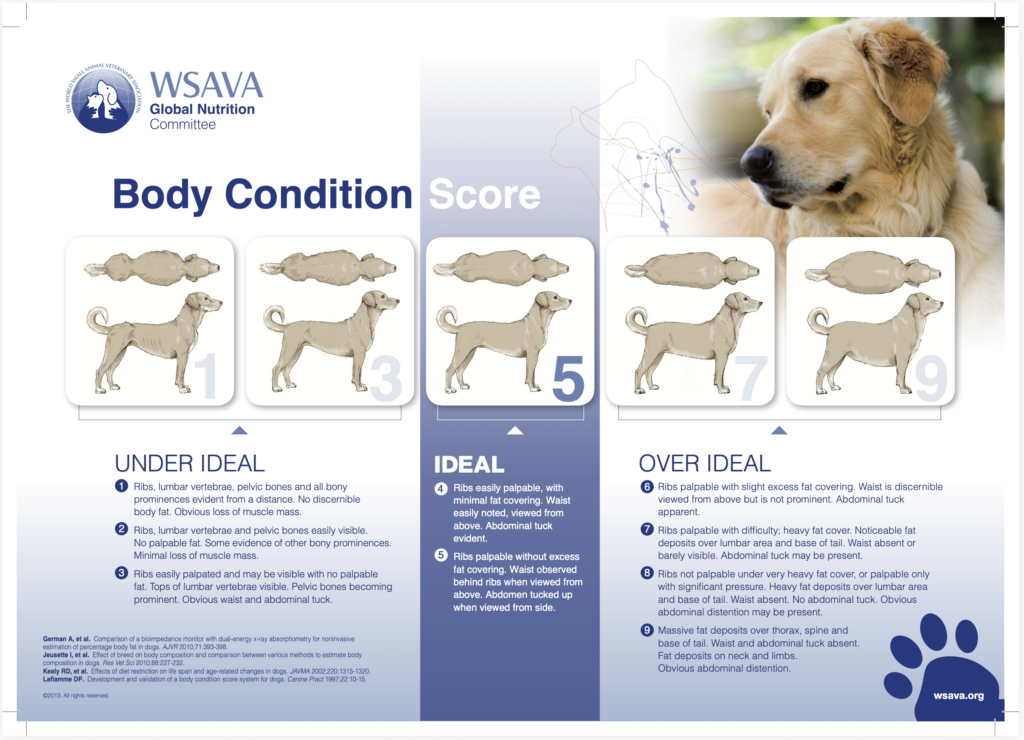
• On this scale from 1 to 9:
• 1-3: Weak (bones prominent, muscle mass low)
• 4-5: Ideal (ribs can be felt, waist is prominent)
• 6-9: Overweight/Overweight (waist and ribs cannot be felt, the body takes a round shape)
What Should I Do If My Dog Is Not in Ideal Body Condition?
• If you think your dog is underweight or overweight, you should consult a veterinarian.
• If your dog was previously in ideal body condition but is gaining or losing weight, consider the following changes:
• Diet: Consider whether you have made any changes to your diet, feeding amount, or feeding frequency.
• Reward Foods and Table Scraps: Review the amount of treats or table scraps you give your dog.
• Appetite and Activity: If you notice any changes in your dog's appetite, energy level, or interest in his environment, report them to your veterinarian.
• Environmental Changes: Adding a new pet to the household, a move to a new location, or a change in environment can affect your dog's eating habits.
Body condition scoring is vital to ensuring your dog maintains a healthy weight. Regularly assessing body condition can help detect health issues such as obesity or underweight in your dog early. If you notice any unexpected changes in your dog’s weight, contact your veterinarian. This is one of the best ways to maintain your dog’s overall health and extend their lifespan.
Other Articles You May Be Interested In
“If you believe in science, as I do, you believe that there are certain laws that always apply.”
Stephen Hawking
