Estimated reading time: 4 minutes
Contents
- What is Body Condition Scoring (BCS)?
- Why Is It Helpful to Learn This Technique?
- How to Score Your Cat's Body Condition
- Step 1: Assess Your Cat's Silhouette from Above
- Step 2: Assess Your Cat's Silhouette from the Side
- Step 3: Assess Fatty Tissue in the Rib and Abdominal Area
- Step 4: Use the Body Condition Score Chart
- What Should You Do If Your Cat Is Not in Ideal Body Condition?

What is Body Condition Scoring (BCS)?
Body Condition Scoring (BCS) is a simple technique used to determine whether your cat is underweight, ideal weight, or overweight . This method also allows you to determine how much food to feed your cat to help it maintain a healthy weight.
Why Is It Helpful to Learn This Technique?
Maintaining a healthy weight throughout your cat’s life can reduce the risk of disease and extend lifespan. Excess weight can cause many health problems in cats, including diabetes, joint problems, heart disease, and respiratory problems.
How to Score Your Cat's Body Condition
To assess your cat's body condition, you can follow 4 simple steps:
Step 1: Assess Your Cat's Silhouette from Above
• Look at your cat's back from above.
• A cat in ideal body condition has a distinct “hourglass” shape behind its ribs.
• You can see this shape with your eyes in short-haired cats. In contrast, you may need to feel the shape with your hand in long-haired or thick-furred cats. To do this, you can gently move your hands along the sides of your cat.
Step 2: Assess Your Cat's Silhouette from the Side
• Look at your cat's chest and belly from the side.
• In a cat with ideal body condition, the abdominal area should appear pulled upwards.
• It may be difficult to see this shape in long-haired cats. Therefore, you should feel whether your cat's abdomen is lifted upwards by gently touching its chest and abdomen with your hand.
Step 3: Assess Fatty Tissue in the Rib and Abdominal Area
• With your hands, gently stroke your cat's rib area just behind the shoulders.
• The ribs should be easily palpable, with a thin layer of fat covering them. In an ideal body shape, the ribs should feel like "bones on the back of your hand," thanks to the fat layer on top.
• Next, touch your cat's belly. A cat in ideal body condition should not have excess fat in the belly area.
• Note: The amount of fat over the ribs is important when assessing your cat's condition. However, some cats may have very little fat over their ribs but still accumulate fat in the abdominal area. Cats with an abdominal "fat pocket" (abdominal fat pad) are considered overweight even if their ribs feel thin.
Step 4: Use the Body Condition Score Chart
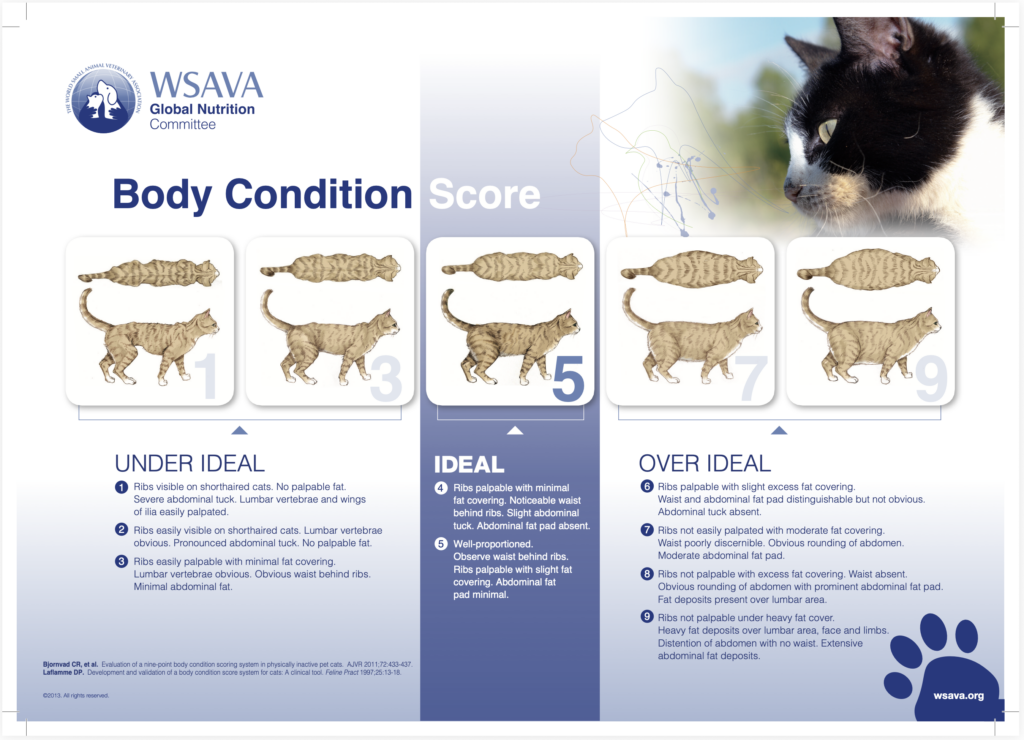
• Evaluate the information you collect at each step according to the body condition scoring system.
• Body Fitness Score (BCS) is generally assessed on a scale of 1 to 9.
• 1-3: Thin (prominent bones, very little body fat)
• 4-5: Ideal (ribs palpable, waist defined, abdomen pulled upwards)
• 6-9: Overweight (ribs not palpable, fat accumulation in the abdomen, loss of waist shape)
Also assess muscle condition.
Body condition score indicates fat tissue; it does not indicate muscle mass. In cats with heart disease, monitor not only weight but also muscle wasting in the back, hips, and shoulders. Muscle loss due to heart failure (cardiac cachexia) begins insidiously. This loss can occur even in an overweight cat. It is usually first noticed in the muscles running along the back. For details, see the article on Heart Disease and Nutrition .
What Should You Do If Your Cat Is Not in Ideal Body Condition?
If you suspect your cat is too thin or too overweight, it's important to seek guidance from your veterinarian (see Obesity and Unwanted Weight Loss in Cats and Dogs ).
• When you notice weight changes in your cat, check for the following:
• Has there been a change in the type of food?
• Have food portions changed?
• Are more treats or table meals being given?
• Is there a change in appetite?
• Has a new pet or guest arrived at your home?
• Make changes to your diet:
• These problems can usually be resolved with dietary adjustments. However, if weight loss or weight gain continues, it is important to consult your veterinarian.
• Your veterinarian can assess your cat's dietary habits and then provide a personalized feeding plan to maintain ideal body condition.
Regularly monitoring your cat's physical condition helps you detect weight changes early. It also helps you create the right feeding plan in collaboration with your veterinarian. Ideal physical condition ensures your cat lives a longer, healthier, and happier life.
Remember, early detection of changes plays a major role in preventing illness . Therefore, you should observe any changes in your cat's condition and consult your veterinarian when necessary.
Other Articles You May Be Interested In
“Science is the process that takes us from confusion to understanding.”
Brian Greene
